

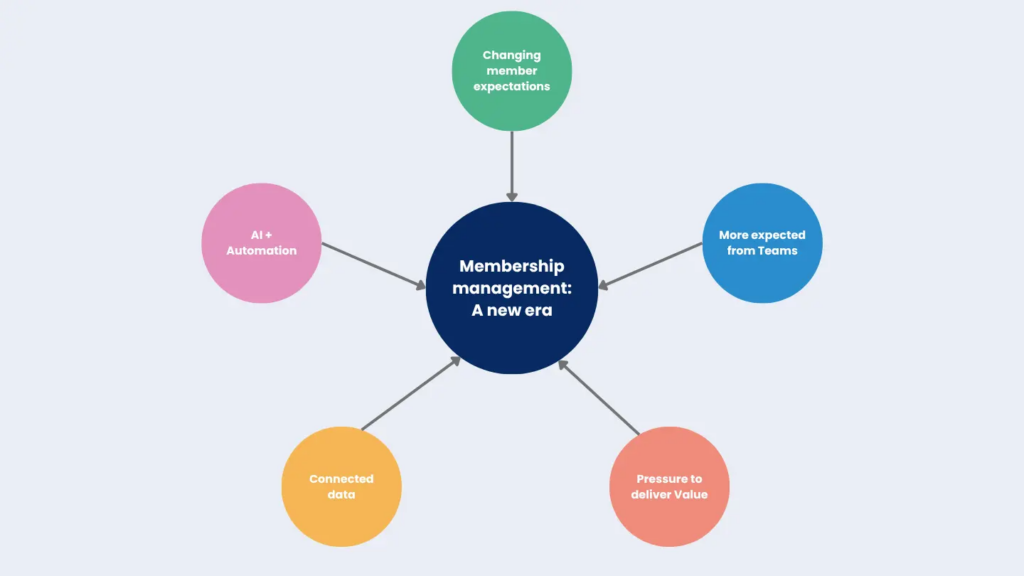
Over the past few years, the membership sector has spent a lot of time talking about digital transformation, AI, automation, engagement and changing member expectations. Usually they’re treated as separate conversations.
But step back and look across the latest industry research, and a different picture starts to emerge. These aren’t isolated trends. They’re all symptoms of the same shift in how membership organisations are expected to operate.
Recent research from Marketing General, MemberWise and American Society of Association Executives (ASAE) covers different markets and uses different methodologies, so the findings shouldn’t be treated as one combined dataset. What’s striking, however, is how consistently they point in the same direction. Membership growth is becoming more difficult. Member expectations continue to rise. AI adoption is accelerating. Financial pressure hasn’t gone away. And organisations are being asked to deliver more value without a corresponding increase in resources.
None of those trends are particularly surprising on their own. Together, though, they paint a picture of a sector that’s going through a significant transformation.
Growth can no longer be taken for granted.
Marketing General’s long running Membership Marketing Benchmarking Report illustrates this well. In 2024, 47% of responding associations reported membership growth. That fell to 45% in 2025, and the latest research found that only 38% increased membership over the previous year.
That doesn’t mean membership is in decline. Far from it. What it does suggest is that growth is becoming harder to achieve. Organisations can no longer rely on recruitment alone. Retention, engagement and consistently demonstrating value are becoming increasingly important because members now have more choice than ever about where they invest their time, attention and money.
At the same time, financial pressures continue to shape strategic decisions. ASAE’s 2026 State of Associations research found that almost 39% of CEOs reported financial decline, while nearly two thirds were actively pursuing partnerships and over 60% were diversifying revenue streams. Rather than standing still, organisations are looking for new ways to strengthen their long term sustainability.
The common thread isn’t retrenchment. It’s pressure to create more value from the organisation that’s already there.
Membership teams aren't necessarily smaller, but the job is getting bigger.
It’s easy to assume that this is simply a story about reducing headcount. The evidence suggests something more nuanced.
ASAE found that just over half of associations maintained staffing levels during the previous year, with around a quarter increasing staff. Most expected staffing to remain broadly unchanged over the coming months.
The challenge isn’t necessarily fewer people. It’s that those people are expected to do considerably more.
Today’s membership teams are expected to recruit and retain members, run events, deliver communications, understand engagement, improve digital experiences, introduce automation, explore AI and make better use of data, all while continuing to deliver excellent service to members.
That’s a very different role from even five years ago.
MemberWise’s latest Digital Excellence research reinforces this picture. While automation and AI adoption continue to increase, many organisations still struggle with fragmented systems, manual processes and disconnected data. Its research also identifies measuring member engagement as one of the sector’s biggest challenges.
This is where the conversation around membership management starts to change.
Operational efficiency isn’t simply about making administration easier. Every hour spent updating spreadsheets, reconciling payments or moving information between disconnected systems is an hour that can’t be spent creating value for members. Efficiency has become a strategic capability rather than just an operational objective.
Membership expectations are changing too.
Technology isn’t the only force reshaping the sector.
Marketing General’s research shows Millennials now account for around a quarter of association membership, while Generation Z continues to grow as a proportion of the membership base. That trend is likely to continue over the coming years.
It’s important not to overstate generational differences. Not everyone behaves the same because of the year they were born.
What has changed, however, is the digital world members experience every day.
Whether it’s online banking, streaming services or retail, people increasingly expect personalised experiences, intuitive interfaces and immediate access to information. Those expectations don’t disappear when they interact with a professional body or membership organisation.
MemberWise reports that many organisations are investing in personalisation, but relatively few have the connected data needed to deliver it consistently. As expectations continue to rise, that gap becomes harder to ignore.
AI is accelerating an existing transformation.
AI has quickly become one of the biggest talking points in the sector.
Different reports measure adoption in different ways, making direct comparisons difficult, but they all point towards the same conclusion. AI is moving rapidly from experimentation into everyday use.
What’s particularly interesting is where it’s being used.
Most organisations aren’t replacing member services with AI. They’re using it to help staff work more efficiently by creating content, analysing information and automating repetitive tasks.
That makes perfect sense, as the industry evidence suggests Membership teams have a capacity problem.
AI can certainly help address that, but only if the underlying data is accurate and connected. Fragmented member records, disconnected systems and inconsistent processes don’t become less important because AI is introduced. If anything, they become even more significant.
The quality of AI will always depend on the quality of the information behind it.
A different model of membership management is emerging.
Each of these industry reports measures something different. Membership growth. Digital transformation. Financial performance. Technology adoption.
Yet they’re all pointing towards the same conclusion. Membership organisations are entering a new operating model.
Success is no longer defined simply by recruiting new members or running efficient administration. Organisations increasingly need to understand engagement, make better use of data, personalise experiences, adopt new technology and continually demonstrate value, all without dramatically increasing resources.
That changes what good membership management looks like.
It’s no longer just about maintaining accurate records or processing renewals efficiently. Increasingly, it’s about creating organisational capacity, connecting information, identifying opportunities earlier and helping teams make better decisions with the resources they already have.
The organisations that thrive over the next decade probably won’t be those with the biggest teams or the longest list of member benefits. They’ll be the ones that adapt fastest to this new reality.
The individual trends are already visible. The opportunity now is recognising the bigger story they’re telling together.