
How to Choose Membership Management Software in 2027
To choose membership management software ahead of 2027, begin with the challenges your organisation needs to solve, the member journeys you want to improve and the operational capacity available to manage change. The right platform should connect member data, reduce administration and support the services and experiences that make membership valuable.




The context for membership organisations
Industry research shows membership organisations have three major challenges:
Member engagement
Engagement and retention are difficult to see before renewal
FROM MEMBERWISE RESEARCH
Operational pressure
Teams face rising workload without equivalent growth in resources or budget
SECTOR-WIDE CHALLENGE
AI readiness
Adoption is moving faster than data quality and governance control
2027 PRIORITY
Membership management software is a platform that helps organisations manage member records, applications, renewals, payments and services. More complete platforms connect those administrative processes with communications, events, self-service, community and engagement insight.
Fragmented data across member management systems makes engagement harder to understand, reporting more labour-intensive and AI less reliable. The technology you use to manage your membership affects far more than membership administration.
START WITH THE PROBLEM
Six challenges your next platform should solve
Engagement appears too late
Spot declining participation before a member decides not to renew.
Data lives in silos
Connect activity held across CRM, events, email, and finance systems.
Admin consumes capacity
Remove repetitive work so teams can focus on delivering member value.
Members expect connected experiences
Create a coherent experience across joining, events, and self-service.
Membership is complex
Support organisations, grades, branches, committees, and roles.
AI needs strong foundations
Build reliable, permissioned data before adding automated decisions.
WHAT TO LOOK FOR
Four pillars of modern membership software
A scannable overview, with detailed supplier questions within each section.
Understand your members
- Connected member records
- Engagement insight
- Reporting that informs decisions
Improve the member experience
- Member self-service
- Community and participation
- Personalised communications and services
Simplify membership operations
- Support for complex membership models
- Automation
- Purposeful integrations
Build a sustainable foundation
- Configuration and flexibility
- Implementation support
- Security, data governance and responsible AI
Questions to ask membership software suppliers
- Can you demonstrate our complete joining and renewal journey?
- Which activities contribute automatically to the member record?
- Which capabilities are native and which require integrations?
- How does the platform support organisational members, multiple contacts and different permissions?
- What can our own team configure without supplier intervention?
- What implementation, migration and training support is included?
- How will the complete solution be priced over three years?
- How is member data protected, exported and deleted?
- If AI is included, which data does it access and how are its outputs governed?
Turn these priorities into a structured comparison
Your 2027 shortlist
Your membership software shortlist should include:
- Connected member data
- Engagement insight
- Applications, renewals and payments
- Member self-service
- Events and communications
- Community and networking
- Complex membership support
- Configurable automation
- Useful reporting
- Data governance and AI readiness
- Supported implementation
- Transparent long-term cost
How to evaluate platforms:
Define the outcomes
Identify what should improve for members, employees and leadership.Choose priority journeys
Select realistic scenarios such as joining, renewing, booking an event and identifying disengagement.Request comparable demonstrations
Ask each supplier to demonstrate the same journeys rather than delivering a generic product tour.Evaluate the complete operating model
Compare implementation, usability, support, integrations and long-term cost alongside functionality.
What's your current membership management really costing?
Common mistakes to avoid
Recreating every current process
A platform change is an opportunity to remove duplication and rethink work that has accumulated around old limitations. Preserve necessary controls and genuinely valuable practices, but do not treat familiarity as proof that a process should survive.
Giving every requirement equal importance
Separate essential outcomes from desirable features and rare edge cases. A heavily weighted requirement that affects every member should matter more than an impressive capability used once a year.
Selecting on the ideal demonstration path
Test exceptions, permissions and handoffs. This is where hidden work and product limitations are most likely to appear.
Comparing licence prices in isolation
Include implementation, integrations, other retained products and internal administration. Compare at least three years where possible.
Underestimating adoption
Usability, training, documentation and continuing support determine whether functionality creates value. Involve employees early and prepare them for improved processes, not only a new interface.
Treating go-live as the finish line
Plan how the organisation will review adoption, data quality, workflows and member behaviour after launch. Improvement should continue as the team learns what the connected information makes possible.
Ready to build your membership software shortlist?
Why organisations choose VeryConnect
VeryConnect is a configurable, connected membership management platform for professional bodies, associations, societies, charities, alumni organisations and other member-led communities.
It brings membership CRM together with applications, renewals, payments, communications, events, websites, self-service, community, mentoring and engagement insight. Organisations choose the functionality relevant to their needs, with integrations available where retaining another product provides a genuine advantage.
The implementation is designed as a collaborative optimisation project. VeryConnect works with the customer to understand its membership structure, review data and processes, configure useful workflows, migrate and test information, train employees using their own setup and prepare for launch. Support continues as requirements evolve.
Explore VeryConnect customer case studies to see how different organisations have simplified operations, automated administration and improved member experiences.
A connected platform, configured around your organisation
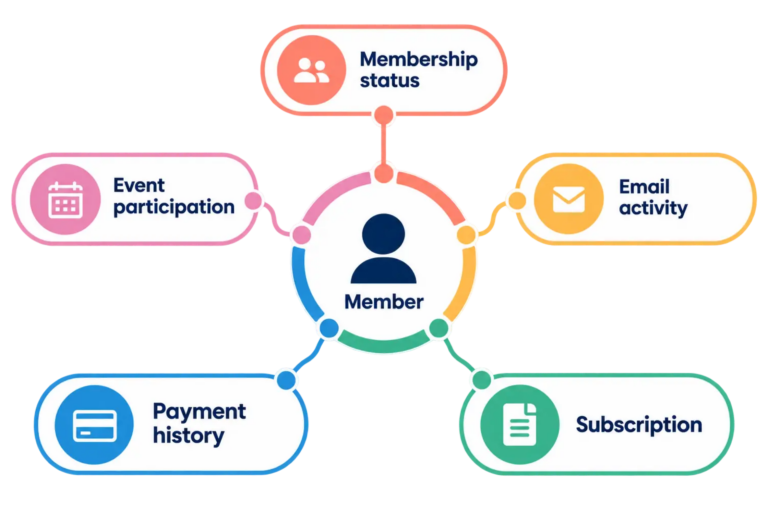
See the whole member relationship
CRM, payments, events, communications, community and engagement activity contribute to one connected view.
Choose the functionality you need
The platform is configured around your membership structures, processes and priorities.
Improve the operation during implementation
VeryConnect helps optimise data, workflows, training and adoption, not simply move existing processes into new software.
How is VeryConnect helping people like you?
Pricing at a Glance
VeryConnect Lite
Typical Investment:
- From £3,000 per year
- Plus £3,000 one-off set up fee
Best for: Alumni associations and smaller membership organisations looking for an out of the box membership management solution
Most Popular
VeryConnect Pro
Typical Investment:
- From £16,000 per year
Best for: Professional bodies, associations, institutes, charities, and membership organisations requiring advanced member management, events, communications, renewals, reporting, and engagement tracking.
VeryConnect OS
Typical Investment:
- From £29,000 per year
Best for: Larger organisations with complex membership structures, multiple member types, advanced automation, and enterprise integrations.
Ready to Compare Membership Management Software Providers?
Once you’ve identified your organisation’s requirements and priorities, the next step is to explore which membership management platforms are best suited to your needs.
Different providers offer varying levels of functionality, flexibility, implementation support and pricing. Comparing these options can help you build a shortlist and make a more informed decision.
Explore our Best Membership Management Software for 2027 guide for a comparison of leading platforms, their key features and the types of membership organisations they’re best suited to.
Frequently asked questions
Membership management software helps organisations manage member records, applications, renewals, payments and related administration. More complete platforms can also connect communications, events, websites, self-service, community, mentoring and engagement reporting around the same member information.
The appropriate functionality depends on the organisation. Common requirements include CRM, online applications, subscription and payment management, automated renewals, member self-service, communications, events, reporting and secure permissions. Professional bodies and associations may also require organisational membership, CPD, committees, branches, mentoring or community features.
A CRM primarily stores contact information and records relationships. Membership management software adds processes such as joining, renewals, payments, member access and self-service. A connected membership platform combines these administrative functions with the wider services and interactions through which membership value is delivered.
Costs vary according to membership size, functionality, users, configuration, migration and integration requirements. Buyers should compare implementation and ongoing operating costs alongside the licence. Published VeryConnect pricing currently begins at £3,000 per year for Lite, from £16,000 per year for Pro and from £29,000 per year for OS.
Timescales depend on data quality, complexity, integrations, internal availability and the scope of change. Most VeryConnect customers go live within 8 to 12 weeks. Larger or phased programmes may take longer, particularly where several websites, affiliates or specialist workflows are involved.
Give shortlisted suppliers the same requirements and real-life scenarios. Compare connected operations, efficiency, member intelligence, membership capability, member experience, implementation, future readiness and total value. Record evidence and assumptions alongside any numerical score.
Not necessarily. Keep specialist products where they provide enough value to justify the integration and ongoing ownership. The aim is to establish a connected foundation for core membership operations and make deliberate decisions about what remains outside it.
Common warning signs include repeated data entry, manual reporting, difficult integrations, limited self-service, poor visibility of engagement, slow process changes and dependence on a small number of employees who understand the setup. Assess the combined pattern and operational cost rather than waiting for a single major failure.