

Budgets shape what membership organisations can deliver. From the services available to members, to the capacity of the team supporting them. With operating costs rising and expectations growing, every investment needs to earn its place. MemberWise’s financial benchmarking highlights this pressure, pointing to the need for organisations to demonstrate value, strengthen engagement and protect their long-term sustainability.
Against that backdrop, it’s understandable that budget is one of the first things buyers ask us about when exploring membership management software. You need to know what you can afford, what’s included and whether the investment will make a meaningful difference. But answering those questions starts with understanding what your current setup really costs.
Your CRM subscription looks reasonable. So does the email platform, the event booking tool and the software connecting them. It’s only when someone asks what the whole setup costs that the answer gets a little less comfortable.
Then there’s the spreadsheet someone updates every Friday, the payment records that need checking before renewal reminders go out, and the colleague who knows how to make all the numbers agree. None of that work appears on a software invoice. All of it uses time and capacity your organisation could put towards supporting members.
If you’re comparing membership management software costs, those demands belong in the calculation alongside the licence fee. A collection of affordable tools can become expensive to operate when your team has to keep joining the dots between them. Understanding that full cost gives you a stronger basis for deciding where to invest, what to simplify and how to make your budget go further.
How much should you budget for membership management software?
Membership management software can cost less than £100 a year or involve an annual investment of tens of thousands of pounds. That’s a substantial difference, but the label covers everything from tools for running a local club to configurable platforms supporting professional bodies, trade associations and international membership organisations. A useful budget starts with understanding what you need the software to do.
For straightforward membership administration, the investment can be modest. MemberMojo, for example, publishes a free plan for up to 50 members, £50 a year for up to 100, and £95 a year for up to 500, inclusive of VAT. That £95 plan works out at just under £8 a month, although billing is annual and payment processing fees are additional. If your club needs member records, online renewals, payment collection and straightforward communications, a low-cost tool could cover your requirements perfectly well.
The budget changes when you need technology to support more of your operation. Organisational memberships with multiple contacts, different access permissions, committees, CPD and member services introduce requirements beyond maintaining a database and collecting subscriptions. Connecting those activities with events, communications and engagement reporting also gives your team a fuller understanding of each member’s relationship with your organisation.
That’s why membership numbers alone won’t tell you what you should spend. Two organisations with 5,000 members could need very different solutions: one might have a single membership category and an annual renewal, while the other manages corporate accounts, regional groups, professional development and a busy events programme. The functionality, configuration, integrations and implementation support each requires will shape the price.
Flexible platforms give you scope to match that investment to your needs. You can bring core membership activities together, choose the capabilities that support your services and retain specialist tools where they add value. When comparing options, establish what’s included, how the platform can adapt as your requirements change, and what you’ll still need to run alongside it.
VeryConnect takes this approach through its Lite, Pro and OS options, with annual subscriptions starting from £3,000, £16,000 and £29,000 respectively. Lite supports more straightforward membership requirements, while Pro and OS offer broader functionality, configuration and integrations. Our pricing page explains the options, including implementation costs, to help you identify a realistic starting budget.
Whatever your budget, the subscription is only part of the calculation. A low-cost tool can be excellent value when it covers the work you need it to do. But if you’re continually adding software, connectors and manual processes to fill the gaps, the original price tells you less and less about what you’re actually spending.
That’s how tech cost creep takes hold. Each addition solves an immediate problem, while the combined cost of the systems and the effort needed to run them becomes harder to see. To compare your options properly, you need to bring that whole picture into view.
How tech cost creep happens
Most membership teams don’t deliberately design a complicated technology stack. They solve the problem in front of them: a better way to send emails, manage conference bookings or give members access to resources. Each addition makes sense at the time.
Over a few years, those decisions accumulate. An introductory price expires, your contact database moves into a higher pricing band, an extra user needs access, and another connector becomes necessary. Meanwhile, several products may offer overlapping features, even though you’re paying for all of them.
The less visible creep happens between the systems. Someone exports event attendance into the CRM, checks membership status before sending a campaign, or reconciles payments against a separate list. The software bill grows, but so does the amount of human effort needed to keep everything moving.
What should total cost of ownership include?
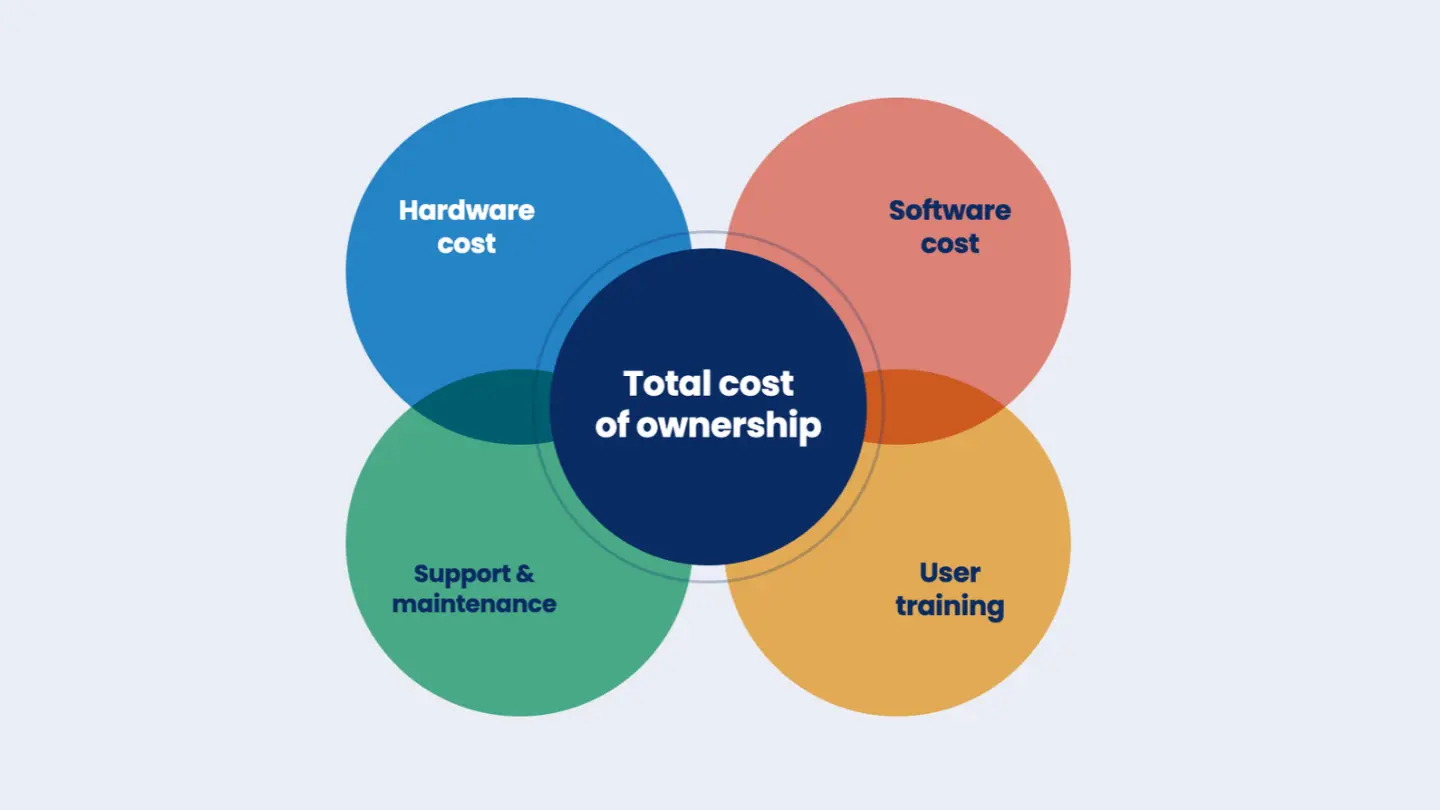
The total cost of ownership of membership software includes getting the solution into use, running it day to day and adapting it as your organisation changes. Subscriptions, implementation, migration, configuration, integrations and support all belong in the calculation. So does the time your team spends making everything work, both during the initial project and long after launch.
Implementation is a good example of why the supplier’s fee only tells part of the story. Your team may need to clean data, agree workflows, test migrated records, attend training and support members through the change. Even where onboarding is included in the price, that internal involvement needs time and resources.
Once the system is running, pay attention to the work that happens around it. Preparing reports, rekeying contact details, correcting duplicate records and answering questions members could resolve through self-service all consume capacity. Familiarity can make these tasks feel unavoidable, even when they’re compensating for gaps in the technology.
Ten hours of avoidable administration each week, across 46 working weeks, represents 460 hours a year. At a fully loaded staff cost of £30 an hour, including relevant employment costs, that’s £13,800 of capacity. Use your own team’s costs and observed working patterns to build a realistic estimate.
Recovering those hours won’t automatically reduce your payroll by £13,800. It could give your existing team more room to support members, develop services or deliver events without continually adding to their workload. For volunteer-led organisations, the hours still matter: volunteer availability is a finite resource, even when there’s no salary attached.
Integrations need attention too, because connecting two systems doesn’t necessarily remove the work between them. A connection that transfers contact details may still leave someone reconciling membership status, payments or event activity. Establish who maintains each integration, how failures are identified and what happens when either system changes.
Consider how much of the setup also depends on individual knowledge. If only one person understands the renewal spreadsheet or the sequence needed to produce a board report, leave and handovers become harder to manage. Documentation, training and cover take resources, and a setup that’s cheap to subscribe to can be expensive to depend on.
Finally, look at how costs could change over the next three years. User limits, contact bands, email allowances, transaction charges, additional functionality and future configuration can all affect the bill. Comparing those costs alongside implementation, ongoing administration, renewal terms and data export charges gives you a more useful picture than the first-year subscription alone.
What could the numbers look like in practice?
Consider an illustrative association paying £5,000 a year for its CRM, £2,400 for email software, £1,800 for event software and £1,800 for connectors and maintenance. Its annual technology spend is £11,000. If the team also spends 12 hours a week on the administration to run these tools, over 46 weeks at £30 an hour, that adds £16,560, bringing the annual operating cost to £27,560.
Now suppose it receives a £16,000 annual quote for a connected platform covering the agreed requirements. Most of its existing membership tools would be replaced, but it identifies £2,000 a year of specialist software it still needs to keep. That brings its total annual technology spend to £18,000 before accounting for staff time. An assessment of its workflows suggests the same administration could fall to five hours a week. At the same hourly rate, that produces an annual operating cost of £24,900, including £6,900 of staff capacity.
The software spend has increased by £7,000, yet the combined annual operating cost has fallen by £2,660. The team would also recover 322 hours a year. That’s why the licence comparison alone can point you towards the wrong conclusion.
These figures are a worked example, not a VeryConnect quotation or a forecast of customer savings. The assumed reduction in administration would need testing against real workflows, and any tools retained must remain in the budget. Don’t add the value of the recovered hours to the £2,660 again, because those hours are already included in the calculation.
The transition changes the first-year picture too. If internal migration, testing and training require a further £4,000 of staff time, the new setup’s first-year cost becomes £28,900. Assuming unchanged annual costs, no other transition charges and no overlapping subscriptions, the three-year comparison would be £82,680 for the existing setup against £78,700 for the new one.
For a smaller organisation, the decision could be simpler. VeryConnect Lite’s published starting price implies £6,000 in supplier fees in year one and £3,000 annually after that, or £12,000 over three years before other applicable costs. Whether that’s good value depends on the work it replaces, the functionality needed and the internal effort involved, rather than membership numbers alone.
What’s your current setup really costing?
You don’t need a full procurement project to establish a useful starting point. Gather your current subscriptions, identify the recurring membership tasks that consume time, and ask the people doing them what happens during a normal month and a renewal peak. Count each task once, particularly where several people contribute to the same process.
Our Membership Admin Cost Calculator helps you bring technology spend together with time spent on renewals, routine member administration and events. It also shows membership revenue at risk separately. Use the results to identify where a closer look could be worthwhile, then add migration, training and other project costs when comparing replacement options.
Keep potential retention improvements separate from confirmed operating efficiencies. A smoother renewal journey could help, but you shouldn’t assume every lapsed membership would have been recovered by different software. A business case that stands up on realistic costs and observable work is far more useful than an impressive number built on optimistic assumptions.
Where a connected membership platform earns its value
VeryConnect brings membership CRM, renewals, payments, events, communications and member self-service together, with functionality configured around your requirements. The commercial advantage comes from reducing the duplication and handoffs that build up when those activities sit apart. A member updating their details, renewing or booking an event should create useful information without your team having to rebuild the connection afterwards.
That can improve more than administrative efficiency. Connected activity gives your team a clearer basis for understanding participation and deciding where support is needed. Time previously spent assembling a picture of your members can be spent acting on it.
The Australian Anthropological Society’s experience illustrates the operational value. It brought membership and conference processes together with VeryConnect, simplifying administration and making future handovers easier. The Society hasn’t formally measured its time savings, but its administrator reported less time spent on day-to-day maintenance.
You may still have specialist tools worth keeping. The important decision is whether each one adds enough value to justify its subscription, integration and ongoing administration. Consolidation works best when it removes unnecessary complexity while preserving the capabilities your organisation relies on.
Compare the work, as well as the price
When you’re evaluating suppliers, ask them to demonstrate the same everyday tasks using scenarios that reflect your organisation. Follow a member from joining through payment, event booking, communication and renewal, including what happens when something changes or goes wrong. Watch for the points where someone needs to export a file, update a second record or ask another supplier for help.
Then ask for a costed proposal covering that complete setup over three years. Our guide to choosing membership management software includes an evaluation framework to help you compare requirements, demonstrations and long-term ownership. It gives your team a shared basis for deciding what matters and recording the evidence behind the decision.
The right investment should make your membership organisation easier to run and better able to deliver value. To explore what that could look like, book a VeryConnect demo and bring the processes that take more effort than they should. We’ll explore how they could work in a connected platform, alongside the scope and investment your organisation would need.